
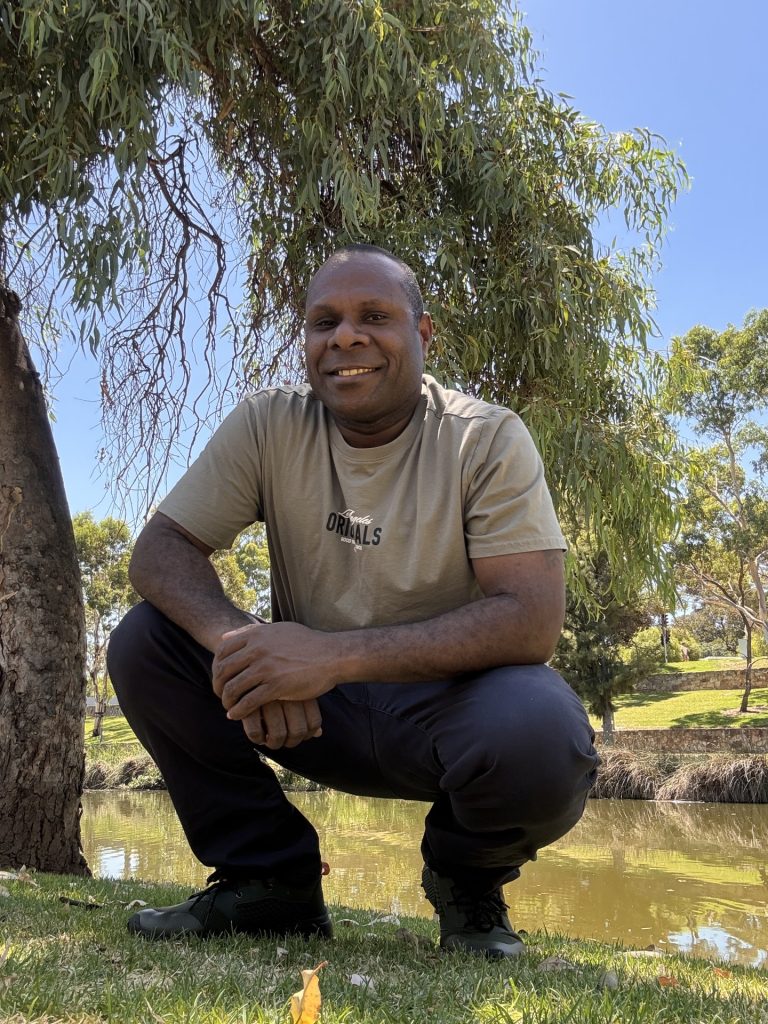
Sailas Tipayamb, an Australia Awards scholar from Papua New Guinea, has just started an International Master of Business Administration at the Adelaide University.
As the world marks World Water Day 2026, we focus on Water and Gender: Where water flows, equity grows, a theme closely aligned with Sailas’ professional and academic journey. His commitment to strengthening fair, reliable, and inclusive water services reflects the broader global call to ensure that water access supports dignity, opportunity and equity for all.
Sailas shares his aspirations as he commences his studies, a pathway to contribute to meaningful change at home.
Water access is fundamental to equity because water insecurity affects women and men differently, often in unseen ways. While women bear the physical burden of water collection and household management, men experience psychosocial stress linked to their traditional roles as providers. Beyond health and sanitation, water scarcity contributes to emotional distress, conflict and social isolation. Equitable and reliable water access reduces these hidden burdens and restores dignity, wellbeing, and opportunity for all.
Fundamentally, as a practitioner my work is about making the invisible visible, embedding safeguards, equity, accountability and human wellbeing into technical engineering systems so that infrastructure does not merely deliver water, but delivers fairness, legitimacy, and long-term sustainability. This, however, comes with significant and persistent challenges.
My studies look at fairness in water access, not just whether pipes and pumps exist. Instead of focusing only on infrastructure, I examine how decisions about water are made, who plans the projects, who controls the money, who carries the risks, and who benefits in the end. I have learned that many water projects fail not because of poor engineering, but because of weak management, unfair procurement, unclear responsibilities and power imbalances. Tools like project schedules and technical designs are important, but they cannot fix problems caused by poor governance and human behavior.
By studying how organisations work, how supply chains operate, and how people behave in workplaces, I aim to clarify why well-intended policies, and technical solutions often do not translate into fair and reliable water services for communities.
When I return home, I will use my skills to strengthen the systems behind water services, not just individual operations or projects. My focus will be on improving how technical teams are organised, how decisions are made, and how work is coordinated so that services continue to function even when resources or capacity are limited.
Rather than relying on short-term fixes or personal influence, I wish to help build clear procedures, strong coordination, and accountable systems that allow executioners to perform consistently over time. By bringing together technical experts, administrators and communities, I will help align planning, implementation and learning. This will improve efficiency, build trust and ensure that essential services like water are delivered fairly, reliably, and with long-term positive impact.
